Native and non-native perceptions of Norwegian accents

Kamil Malarski, Magdalena Wrembel, Kamil Kaźmierski, Witosław Awedyk

57th Annual Meeting of the Societas Linguistica Europaea

August 21st, 2024, Helsinki

norwegian-accents-sle2024.netlify.app

Accent and dialect variation in Norway

  • High dialectal variation across all linguistic domains i.e. morphosyntax, phonology, lexicon
  • Four broad dialect areas, in fact many more, including sociolects (Helleland and Papazian 2005)
  • South-Eastern accents seen as the most standard (Johnsen 2015)
  • Inclusivity towards dialects

Dialectal areas

  • Western Norwegian (Vestnorsk)
  • Eastern Norwegian (Østnorsk)
  • Trøndelag dialect (Trøndersk)
  • Northern Norwegian (Nordnorsk)

Why some accents are seen as better or worse than others

  • Accents as indexes of how people from the region are seen
  • Dependent on salient, easily identifiable linguistic features (Llamas et al. 2016)
  • The person “down the street” will always have a stronger accent than the person you are talking to (Preston and Niedzielski 2003)
  • Voice parametrics (f0 especially, creaky voice)
  • Intelligibility + mergers potentially causing misunderstandings (Labov 2010)

Perceptions of Norwegian accents (1/2)

  • Stratified socially (Johnsen 2015)
  • Western Oslo accents more prestigious than working-class or multicultural Oslo accents (Aasheim 1995, Johnsen 2015, Svendsen and Røyneland 2008)
  • Northern Norwegian accents perceived more negatively than Southern (Sollid 2014)

Perceptions of Norwegian accents (2/2)

  • Mixing or switching between dialects seen negatively (Røyneland 2017)
  • Non-Oslo dialects viewed as more Norwegian (Røyneland 2017)
  • Boys with foreign appearance seen as less Norwegian when using Oslo dialect than when using other dialects (Røyneland 2017: 101)

Previous studies :: methods

  • A lot of studies on how upper / West Oslo accents and dialects are perceived, both using the verbal guise technique, as well as surveys in different forms (Dahl 2002; Jensen 2006: 73, Lund 2006, Hult 2008, Kristiansen 1995)
  • Nine Norwegian accents tested on a scale from ‘nice’ to ‘ugly’ (Voje 1979)

Previous studies :: findings

  • Positive attitudes in Tromsø towards other dialects (Satermo and Sollid 2021)
  • Changing one’s dialect seen as incorrect (Satermo and Sollid 2021)
  • Negative attitudes by urban Vika speakers towards upper Oslo dialects (Jensen 2006, Lund 2006)

Our Study

Research questions

  1. Are some accents of Norwegian perceived differently than others?
  2. Do L2/L3 learners of Norwegian attribute similar aesthetic judgments to Norwegian speech as Norwegian listeners do?
  3. Are there any acoustic correlates of these judgments (e.g. high-pitched voice, female/male voice, the presence of uvular [ʁ]) ?

Design

  • Online survey in Qualtrics
  • Reading passage in Norwegian (Nordavinden og sola from the Norwegian dialects database www.hf.ntnu.no/nos)
  • Selected speech samples \(N=14\)
    • 10 middle-aged native Norwegians (5 f, 5 m) from five dialect areas: the Tromsø area, Trondheim, Stavanger, Kristiansand, and Oslo
    • 4 controls: non-native accents of Norwegian of different strength (L1 Polish)

Our data (L1 NO)


Our data (L3 NO)


Procedure

7-point Likert scale:

  • Education level
  • Pleasantness
  • Intelligence
  • Prestige
  • Friendliness
  • Self-confidence
  • Distance / proximity

Open questions:

  • Likes / dislikes
  • Characteristic features
  • Region of origin of speaker

Samples presented in randomized order
Duration: ca. 20 mins

Participants :: 3 groups

  • Polish instructed learners of Norwegian living in Poland \(n = 47\)
  • Polish naturalistic learners of Norwegian residing in Norway \(n = 25\)
  • Norwegian native speakers as controls \(n = 45\)

Participants :: profiles

  • Gender (72 f, 39 m, 2 non-binary, 2 undisclosed), Age (mean = 33.5)
  • Residence in Norway (present or past)
  • Length of learning Norwegian
  • Language use frequency
  • Proficiency level in Norwegian, English, Polish

Analyses

  • Likert scale ratings
    • Joint group analysis
    • Across-group comparison
    • Across-accent comparison
  • Attitudes to individual accents (likes/dislikes)
  • Accent identification
  • Characgeristic features of accents (qualitative)

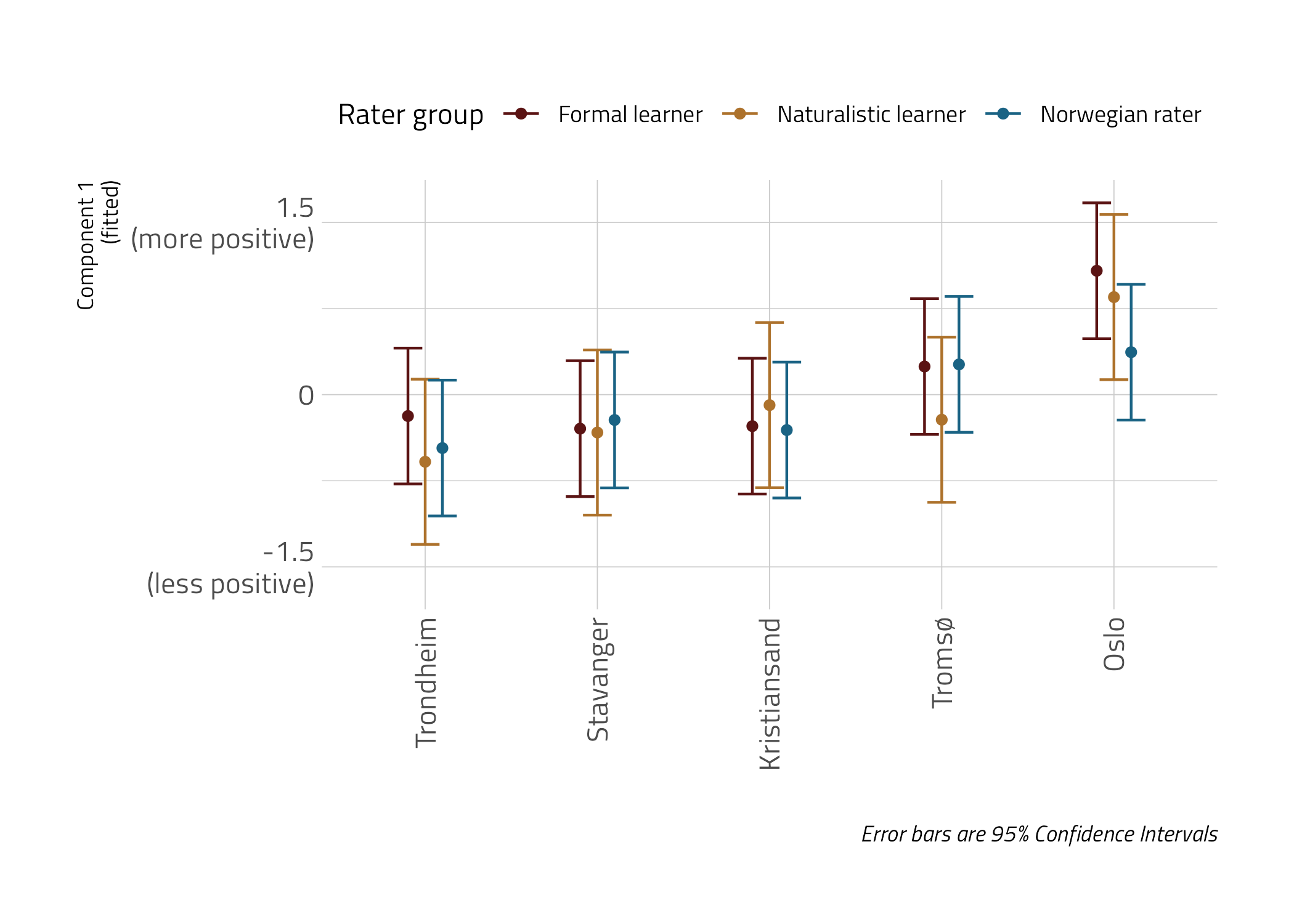
PCA :: Component 1

tinytable_a8slpw2lv1h16uq9iiz1